

Cloud migration is already happening, so why are we pretending it isn’t?
The myth of stalled cloud migration
Spend any time at a broadcast and production industry event today and you’ll hear a familiar narrative: cloud migration has lost momentum. Some say organisations have stopped thinking about it altogether. It’s a neat, attention-grabbing idea, but it oversimplifies what is actually a far more layered reality.
The industry isn’t split between those who are surging towards cloud and those who have abandoned the idea entirely. Cloud adoption has moved beyond these binaries. Some organisations continue to rely on physical setups that serve them well, while others are already reshaping parts of their workflows with virtualised, cloud-native tools. Most fall somewhere in between, making decisions based not on trends but on lifecycles, budgets and operational needs.
Cloud adoption hasn’t gone away. It has simply matured.
What cloud migration really looks like today
A few years ago, cloud migration was positioned as an all-or-nothing shift, the kind of transformation that required ripping up entire workflows. Today, it’s more thoughtful and measured. Instead of sweeping overhauls, teams are gradually evolving how certain parts of their operation work. Clipping, multiformat delivery, graphics, remote production, and multi-feed workflows are often the first to move, not because cloud has suddenly become fashionable again, but because these areas benefit directly from flexibility, scalability and reduced hardware dependency.
Crucially, organisations are no longer treating cloud as a dramatic strategic pivot. It’s simply becoming part of their infrastructure planning. It sits alongside physical investments, not in competition with them.
Why cloud continues to move forward, quietly, but consistently
One of the clearest forces shaping cloud adoption is the lifecycle of existing platforms. Very few organisations will overhaul a working setup halfway through its lifespan. But as hardware approaches end-of-life or reaches a point where upgrades become harder to justify, teams naturally begin to consider whether the next investment cycle should look the same as the last. At that moment, cloud becomes part of the conversation, not because it’s disruptive, but because it offers a way to reduce long-term hardware reliance while opening up more flexible workflows.
This shift is happening alongside a broader change in financial planning. The move from capital expenditure to operational expenditure is already well underway across the industry. As subscription-based models become the norm in other parts of the business, cloud-native production tools slot neatly into this thinking. They offer predictable costs, the ability to scale usage up or down, and far less pressure on multi-year investment planning. Even when cloud isn’t the star of the conversation, the budgeting frameworks around it are quietly taking shape.
Operational demands are evolving too. Production teams now work across linear, digital, social, vertical and multi-platform environments, often simultaneously. They need workflows that can adapt quickly, operate remotely, integrate with metadata and distribution systems, and release new capabilities at a far faster pace than traditional hardware cycles allow. The need for agility has become one of the strongest indicators of where cloud makes sense. It’s not about replacing everything. It’s about modernising where it genuinely enhances how teams work.
A grounded view of cloud: benefits, tradeoffs and the shift towards maturity
Cloud isn’t perfect, and it doesn’t need to be. What matters is that the benefits accumulate over time in ways that physical infrastructure simply can’t match. Lower total cost of ownership, reduced reliance on hardware rooms, the ability to scale instantly for major events and the freedom to operate from anywhere have become meaningful advantages, especially for teams managing growing outputs across multiple platforms.
At the same time, cloud requires careful planning. Connectivity, hybrid workflows and cultural adaptation all play a role in how smoothly organisations transition. But these considerations aren’t signs of stagnation; they’re signs of maturity. Cloud is no longer being sold as a magic solution. It’s becoming part of the normal rhythm of operational decision-making.
How Grabyo fits into this quieter, more pragmatic phase of cloud adoption
Grabyo aligns naturally with the version of cloud most organisations are embracing today. It doesn’t require teams to abandon their existing setups or commit to a complete overhaul. Instead, it complements current workflows by offering a flexible, browser-based environment for live production, clipping, graphics, audio, multiviewing and multi-feed storytelling.
Because it runs in the cloud, Grabyo removes the need for costly hardware refresh cycles and on-prem maintenance. It fits into OPEX-first budgeting models, allowing teams to scale their usage as needed rather than locking themselves into long-term capital projects. And it enables a hybrid approach, where linear-quality broadcasts and digital-first content can be produced side by side, in the same interface, from anywhere.
Most importantly, it gives teams the agility they increasingly need: fast onboarding, frequent feature enhancements, and the ability to adapt quickly to new formats, platforms and audience behaviours.
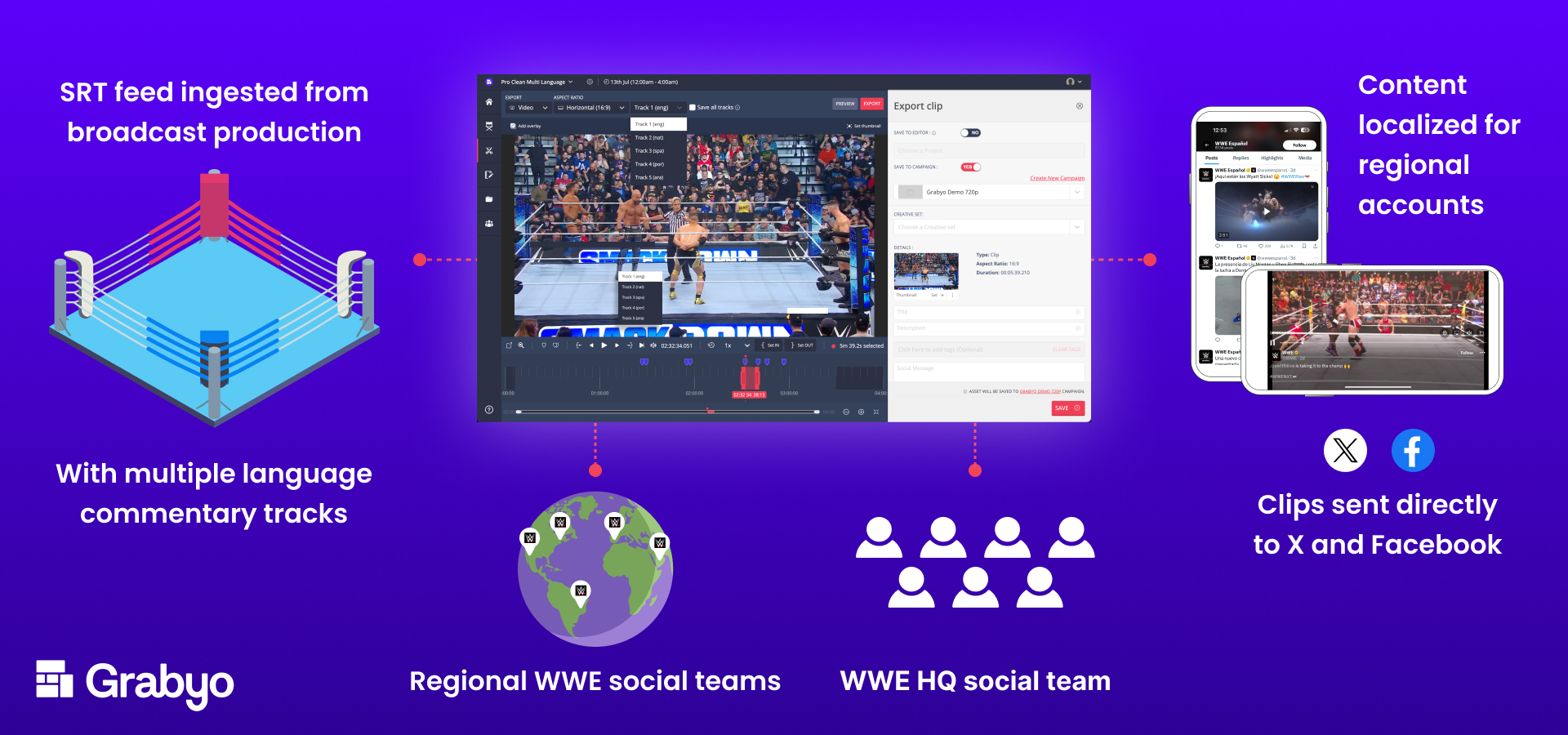
This isn’t cloud as a revolution. This is cloud as a practical step forward. Take a look how the WWE do it below.
The big picture: cloud hasn’t stalled, it has settled
The conversation about cloud may no longer be loud, urgent or speculative. But that doesn’t mean cloud adoption has stopped. Instead, it has settled into the background where strategic decisions get made: at refresh points, during budget reviews, and in the day-to-day realities of producing content for an industry that is no longer defined by a single platform or format.
Cloud has stopped being a headline because it has become normal. And once technology reaches that point, it tends to move faster… not slower.

