

Lessons from Livecon: Why YouTube Live enters a new era in 2026
A turning point for live video on YouTube
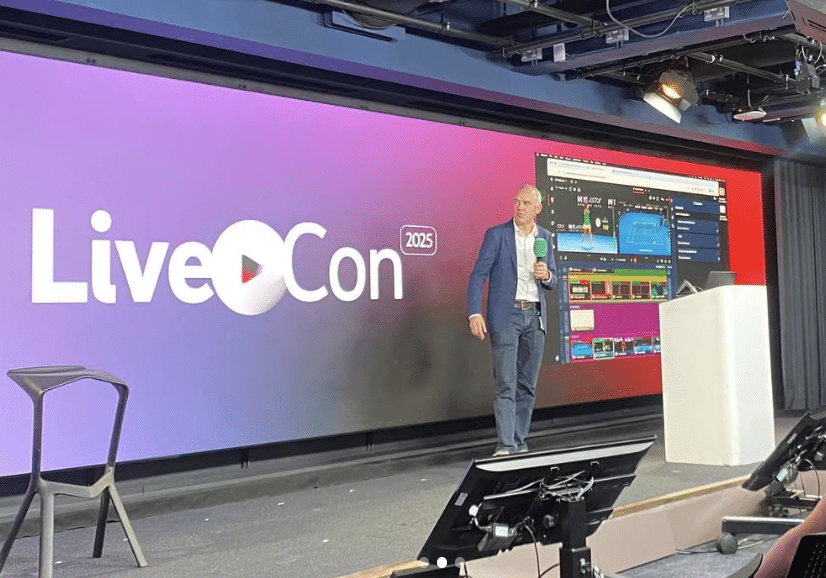
YouTube’s LiveCon 2025 brought together creators, broadcasters and technology partners at a pivotal moment for live video on the platform. As an invited partner, we joined the event to hear directly from YouTube’s product teams, ecosystem partners and creators about where live streaming is heading, what that means for production and distribution strategies over the coming year, and to share our own perspective on the future of live production.
Across the day, one message came through clearly. Live video on YouTube is no longer being treated as a complementary format. It is becoming a core pillar of the platform, designed to support broadcast-scale output, deeper audience engagement and sustainable monetisation.
Producing for the platform: A new wave of live experiences being built on YouTube
At LiveCon, we shared our perspective in a dedicated session exploring how the centre of gravity for live content has shifted. Increasingly, YouTube is where creators, publishers and rights holders are building shows designed to feel native to the platform, rather than adapted from linear television.
As audience expectations continue to evolve, participation, immediacy and community are now fundamental to successful live experiences on YouTube. In response, production models are changing. Traditional broadcast workflows were never designed for this environment. Cloud-based production, flexible team structures and real-time distribution are becoming essential to delivering live content that aligns with how viewers actually watch and engage on the platform.
Live on YouTube is now built for continuity, not just moments
One of the clearest themes across the opening sessions and YouTube-led updates was the shift away from treating live streams as one-off events. Instead, YouTube is deliberately designing live to sit inside a continuous content lifecycle, alongside on-demand and archive content.
Live streams are now expected to do three things well: attract viewers in real time, feed discovery while live, and continue delivering value long after the broadcast ends. The product updates discussed at LiveCon reflected this shift, with live streams more tightly connected to channel strategy, surfaced more intelligently across the platform, and supported by tooling that turns live moments into enduring content.
This matters for broadcasters because it removes one of the biggest historic risks of live production on digital platforms. You are no longer investing purely in a moment. You are investing in an asset that continues to perform.
Discovery is no longer the weak link for live content
Discovery came up repeatedly across sessions focused on YouTube’s evolving ecosystem. Historically, one of the biggest concerns with live streaming on open platforms was reach. If your audience did not show up at the exact right moment, the opportunity was gone.
That is no longer the case.
At Livecon, YouTube outlined how live content is increasingly treated with the same algorithmic care as on-demand video. Live streams benefit from stronger metadata, clearer pre-live signalling, and tighter integration with recommendations across home, search and Shorts. The result is that live broadcasts are easier to find, easier to return to, and easier to repurpose.
For broadcasters used to traditional EPG-driven discovery, this represents a meaningful shift. YouTube Live is no longer dependent on subscribers alone. It is part of the broader discovery engine.
Podcasting has become a live, visual-first format
One of the most interesting parts of LiveCon was how central podcasting has become to YouTube’s live strategy. Multiple sessions explored how podcasts are no longer treated as audio-first or purely on-demand. On YouTube, podcasts are increasingly live, visual and community-driven.
This reflects a broader shift across the industry. High-profile organisations and personalities, including Manchester City FC, Pat McAfee and The Athletic, are increasingly leaning on podcast-led formats to promote tentpole moments, build anticipation and sustain conversation well beyond the live event itself. This year’s Golden Globes marked the inaugural introduction of a podcast category, a positive signal of how seriously the format is now being taken and a clear sign that the line between live shows, podcasts and traditional broadcast is continuing to blur.
LiveCon reinforced that YouTube is positioning itself as the natural home for this convergence. Live podcasting unlocks audience interaction, immediate feedback and a long tail of clips, Shorts and VOD from a single production. For content teams, that efficiency is hard to ignore.
Production expectations are rising, but complexity is not
Another recurring theme across partner and platform sessions was production quality. Viewers now expect live streams to look and feel professional. Clean switching, reliable audio, graphics and multi-camera coverage are becoming table stakes, even for digital-native formats.
At the same time, there was a clear acknowledgement that teams do not want traditional broadcast complexity. The future YouTube is building towards lean crews, remote collaboration and cloud-native workflows.
This is an important distinction. LiveCon did not suggest that YouTube wants everyone to become a broadcaster in the traditional sense. Instead, it is lowering the barrier to producing broadcast-grade outcomes, while keeping workflows flexible and scalable.
Protecting authenticity as AI reshapes live production
AI was present across LiveCon, but notably it was framed as an enabler rather than a replacement. Sessions exploring AI and automation consistently returned to the same point: audiences still value authenticity.
Live remains one of the few formats where imperfections are not only tolerated but expected. What YouTube is doing with AI is removing friction around clipping, optimisation and distribution, not smoothing out the human edges of live content.
That balance is critical. The platform is investing heavily in tools that help teams do more with less, while protecting the qualities that make live compelling in the first place.
Why 2026 is the year to invest seriously in YouTube Live
Taken together, LiveCon painted a clear picture of where YouTube Live is heading and why the next twelve months matter.
First, live is now deeply embedded in YouTube’s discovery and recommendation systems. This significantly de-risks investment for broadcasters, because live output contributes to long-term channel growth rather than sitting outside it.
Second, the platform has matured commercially. Monetisation options around live are more flexible, less disruptive and better aligned with premium viewing experiences. This makes YouTube Live viable not just as a marketing channel, but as a revenue-generating broadcast platform.
Third, audience behaviour has caught up. Viewers are comfortable watching long-form live content on YouTube across devices, from mobile to connected TV. Live is no longer niche. It is mainstream.
Finally, the production ecosystem is ready. Tools, workflows and partners now exist to support consistent, high-quality live output without the cost and rigidity of traditional broadcast infrastructure.
LiveCon was a signal, not a showcase
LiveCon did not feel like a one-off event. It felt like a marker. YouTube is clearly committing to live as a strategic growth area, and the pace of product development suggests that momentum will only accelerate through 2026.
For broadcasters, publishers and content teams weighing up where to place their live bets, the message from LiveCon was clear. YouTube Live is no longer something to experiment with cautiously. It is something to build around.

