

The Buyer’s Guide to Choosing the Best Live Clipping Platform
Live clipping platforms have evolved rapidly over the past few years. But has the way we evaluate them kept pace? Here’s what broadcasters, rights holders and publishers should really be comparing.
The way we produce live content has changed.
The way we buy production technology hasn’t. Not that long ago, choosing a live clipping platform was a relatively straightforward exercise.
Could it create clips from a live feed? Could editors make quick changes? Could content be published to social media before the final whistle?
If the answer was yes, it probably deserved a place on your shortlist.
Today, however, production looks very different. Broadcasters, rights holders and publishers aren’t simply producing more live events. They’re producing significantly more versions of every live event. A single football match might generate horizontal highlights for broadcast, vertical clips for TikTok and Instagram Reels, near-live moments for X, short-form content for YouTube, sponsor deliverables, OTT packages and tailored edits for different markets, often simultaneously.
The audience hasn’t just fragmented. Content has. And while production expectations have accelerated dramatically, many editorial teams are still being asked to do it with the same number of people, the same deadlines and the same pressure to publish first.
That’s why choosing the right live clipping platform has become more important than ever. Not because there are fewer options. Because there are so many. Every vendor promises AI. Every vendor promises faster publishing. Every vendor promises cloud workflows and collaboration. On paper, they can all start to look remarkably similar.
The challenge is understanding what actually matters once the demo ends and real production begins.
Modern production isn’t about creating more content.
It’s about creating more versions of the same moment.
One of the biggest shifts in live production over the last few years has nothing to do with cameras or cloud infrastructure. It’s about outputs. The highlight package is no longer the final product. It’s just one version of it.
Today’s audiences expect content in different formats, on different platforms and at different moments throughout a live event. What performs well on YouTube isn’t necessarily what performs well on TikTok. The clip that works on Instagram isn’t always the same edit that belongs on a broadcaster’s owned platforms.
That has fundamentally changed the role of editorial teams. They’re no longer simply clipping live moments. They’re continuously adapting content for different audiences, different aspect ratios and different destinations.
It’s also why production teams increasingly need technology that supports flexibility rather than forcing every workflow into the same template. The question isn’t simply whether a platform can create clips. It’s whether it can help your team create every version of that clip without multiplying the amount of work involved.
AI has changed the conversation.
But perhaps we’ve been asking the wrong question.
There’s no shortage of AI announcements at the moment. Every month seems to bring another automated workflow, another production assistant or another promise that artificial intelligence will transform live production forever. Much of that innovation is genuinely exciting. But when you speak to editorial teams, the conversation is usually much more practical.
Very few producers want AI making editorial decisions on their behalf. Almost all of them want AI removing repetitive production tasks. That’s an important distinction.
There is less time to manually reframe dozens of clips for vertical platforms. Nobody wants to spend valuable production time generating captions or repeatedly tracking subjects across the same live event.
Those are exactly the kinds of tasks AI should be solving. The editorial decisions, however, still belong to editors. The most valuable AI isn’t the AI you notice. It’s the AI that quietly saves time while allowing production teams to retain complete editorial control.
As AI becomes an increasingly common feature across production platforms, that’s one of the most important questions buyers should be asking. Not “Does it have AI?” But “Does its AI actually make our producers’ lives easier?”
The biggest bottleneck in live production isn’t editing.
It’s workflow.
Most production teams don’t wake up wishing they had another editing tool. They wish they had fewer steps.
Over time, editorial workflows naturally become more complicated. One platform for clipping. Another for captioning. Separate software for vertical video. Different tools for publishing. Spreadsheets keeping track of everything else.
None of those systems are particularly difficult on their own. Together, they create friction. Every export. Every upload. Every hand-off between platforms. Every duplicated task. Those few extra seconds quickly become minutes, especially across hundreds of clips every week.
That’s why the most effective production environments increasingly bring clipping, editing, captioning, reframing and publishing together in one place. Not because fewer applications look better in a product demo. Because fewer moving parts allow editorial teams to focus on creating content instead of managing workflows.
The best platforms don’t ask editorial teams to change.
They adapt to the people using them.
There’s a temptation when comparing software to focus on capabilities. Can it do this? Can it support that? Does it include another feature? Those are perfectly reasonable questions.
But production teams rarely remember software because it offered one more feature than a competitor. They remember whether it felt intuitive. Whether collaboration became easier. Whether onboarding was straightforward. Whether new producers could get up to speed quickly. Whether the platform quietly became part of everyday production rather than something everyone had to work around.
Great production technology often feels surprisingly invisible. That’s usually a sign it has been designed around editorial workflows rather than engineering diagrams.
Technology evolves.
Your production strategy will too.
Most organisations don’t stop at live clipping. As audience expectations evolve, so do production requirements. Teams begin experimenting with vertical-first content. They’re asked to produce more live shoulder programming.
AI becomes part of daily production. New social platforms emerge. Remote contribution becomes routine. Replay workflows become more sophisticated.
The platform that solves today’s challenge should also support tomorrow’s opportunities. That’s why scalability isn’t simply about infrastructure. It’s about giving production teams the confidence to expand their workflows without having to replace the technology sitting underneath them.
So what should you actually compare?
Feature tables still have value. They’re useful for narrowing the field. But they rarely explain what production will actually feel like six months after implementation.
Instead, ask different questions. How quickly can editors move from a live moment to published content? How many manual tasks still exist in the workflow? Does AI remove repetitive work while leaving editorial decisions with producers? Can the platform support the way your organisation is likely to evolve over the next three to five years? And perhaps most importantly… Will your editorial team enjoy using it every single day? Because ultimately, the best live clipping platform isn’t necessarily the one with the longest feature list.
It’s the one that helps your team create more content, respond faster and tell better stories with less effort.

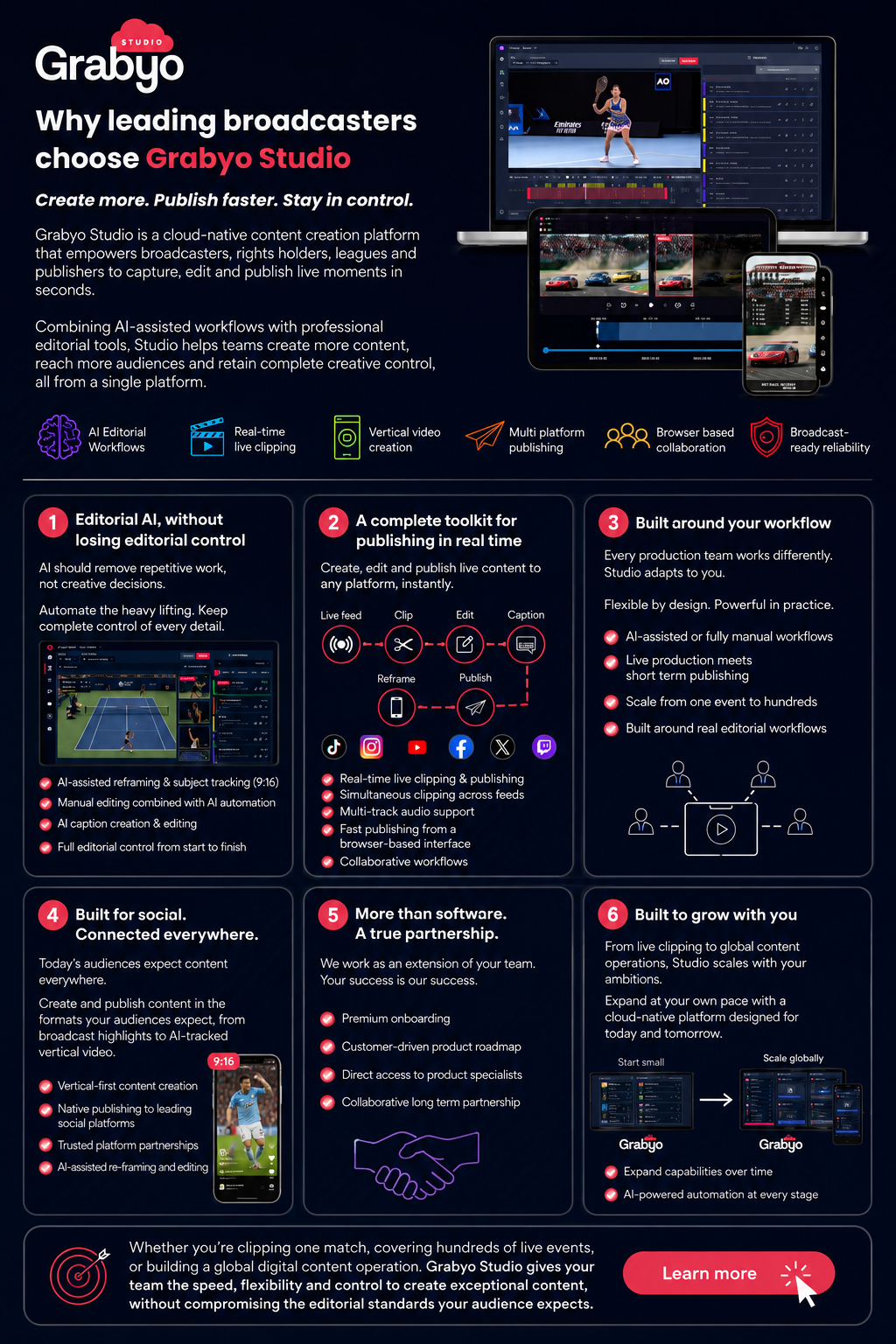
Download the Live Clipping Platform Buyer’s Guide
Choosing production technology is a long-term decision, and comparing specification sheets will only take you so far.
That’s why we’ve created a practical comparison guide designed specifically for broadcasters, rights holders and publishers evaluating today’s leading live clipping platforms.
Rather than focusing solely on features, it explores the workflows, editorial capabilities and production considerations that matter when making a decision, from AI-assisted production and vertical video to collaboration, publishing and long-term scalability.
If you’re currently evaluating live clipping software, we hope it provides a useful framework for comparing your options and identifying the platform that best fits your editorial workflow.
Download the guide and start comparing what really matters.

