
Streamer power play: How streamers are rewriting live sports coverage
When streamers became the broadcasters
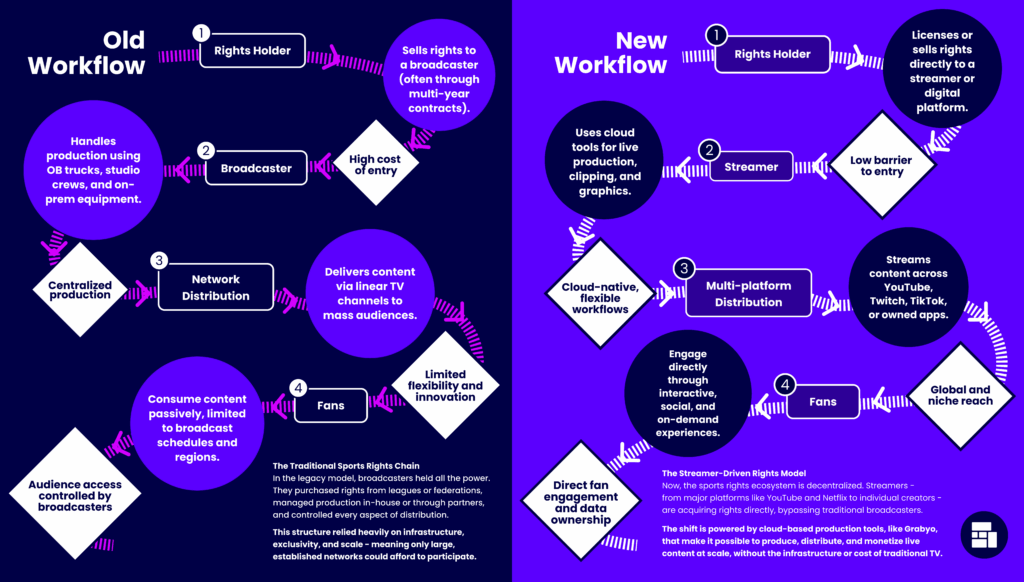
It used to be that broadcasters held all the cards: they bought the media rights, built the networks, and broadcast sports to subscribers – locked behind the paywall. With cracks appearing in the traditional media industry we have seen a shift. Streamers are moving beyond user generated content into the arena of rights ownership, and doing so in a way that changes the game.
Take the recent example from France. A creator named Zack Nani secured the online streaming rights to France’s U21 national soccer team matches, something traditionally handled by broadcasters. The deal grabbed headlines in the sports trade press, signalling more than a clever niche distribution play; it’s a turning point in how sports media is going to be structured from here on.
This shift is huge for creators, but it also presents an opportunity for the production infrastructure services that support them.
The turning tide: Why streamers are now bidding in rights cycles
The numbers tell the story.
Streaming platforms now control roughly one-fifth of all global sports media rights, worth around $12 billion of a $60 billion market in 2025. Just a few years ago, that share was in the single digits. What started as small “digital-only” experiments has become a serious, strategic investment in live sports.
Major streaming players are accelerating investments. DAZN led the charge by picking up the 2025 FIFA Club World Cup, and now (Amazon) Prime Video, YouTube, Netflix, and others are flexing their muscles in the rights market. Even the MLB struck a deal with The Roku Channel to stream Sunday games, a clear sign that league rights holders see value in streaming partners.
The opportunity exists beyond the Tier 1 major sports leagues. Creators are more likely to take on regional, youth, or secondary rights packages, where the risk [for the rights holder] is lower – but the upside (direct fan engagement, control, data) is strong. In Brazil, for example, CazéTV has gone from streaming eSports on Twitch and YouTube to acquiring rights for major national and international tournaments.
These examples tell us two things: one, the creator → rights holder pipeline is real; and two, success depends on matching rights with distribution, monetization, and the ability to deliver a quality output for the audience.
The hidden hurdles: What makes rights ownership hard?
Let’s be honest: rights ownership is attractive in headlines but can be brutal in execution. Producing live sports is not just “turn on a camera and stream.” You need real-time signal ingest, camera switching, complex audio mixing, overlays, graphics, ad breaks, latency control, backups, and multiformat output. Add to that the demands of cloud versus edge infrastructure, reliability, and scale, and things get tricky – fast.
Rights owners and leagues demand strong guardrails: blackout windows, geo-restrictions, watermarking, encryption, and anti-piracy measures. Ensuring compliance, protecting media rights value, and enforcing exclusivity are non-negotiable.
Monetization must be at least as rigorous as broadcast: real-time ad insertion, regional ad targeting, reporting, yield optimization, and revenue reconciliation across platforms. Missed impressions or poor measurement could erode huge amounts of value to streamers.
The tech enabler: a cloud revolution
In this new, creator-driven rights era, the technology underneath makes all the difference.
The best production platforms are built for agility. A creator should be able to bring in live feeds from anywhere, add graphics and branded overlays, manage ad breaks, and deliver across multiple platforms – all without trucks, studios, or complicated hardware setups. The real power lies in doing it all from the cloud, quickly, flexibly and at low cost.
Security and control are equally critical. Rights holders need to enforce geo-blocks, blackout zones, watermarking, and DRM, ensuring that content is protected and compliant. At the same time, monetization must meet broadcast-level expectations: real-time ad insertion, dynamic overlays, and reporting that keeps advertisers confident in their spend.
That’s exactly where platforms like Grabyo fit in. Its cloud-based production tools give streamers and digital networks the same level of control and professionalism that broadcasters have, without the cost or complexity. With real-time clipping, live graphics, seamless ad delivery, and secure feed management, creators can produce ad-ready, broadcast-quality streams directly from a browser.
These live workflows are already in action, powering esports tournaments, youth leagues, and regional sports channels run entirely in the cloud. When streamers acquire rights, they don’t need to start from scratch. They can produce like broadcasters, without the overhead of a traditional TV studio.
Where it’s headed: Scale, localism, and the next rights frontier
The first wave of streamer-owned rights showed what’s possible. The next will show how big, and how local, this movement can get.
In established markets, federations are testing more flexible rights models. UEFA’s upcoming multi-market tender shows how digital distribution is now seen as partnership, not competition, a way to reach fragmented audiences faster. UEFA have also added a new “global game” which is aimed directly at the global streaming platforms such as Netflix and YouTube – a clear attempt to show that global media rights distribution can work for leading sports properties if packaged in the right way.
In emerging regions, mobile-first audiences and creator-led production are filling gaps broadcasters can’t. Mola in Indonesia and CazéTV in Brazil prove that professional live production no longer needs satellites or OB trucks, just the right infrastructure.
For fans, it means more ways to watch what they love. For creators, it’s new ground to own. And for those with the tools to support them, it’s the start of a global, local revolution in live production.
What happens next for sports rights?
The next phase of sports rights will be defined by who can build the biggest audience and show that they can reach fans across the demographic spectrum. Expect more hybrid rights models, including digital-only slices, creator packages, new bundles with global distribution rights, and performance-based packages designed for flexibility, not exclusivity.
Leagues and federations will increasingly rely on streaming partners to innovate, connect with new audiences, and experiment with interactive experiences such as real-time stats, multi-angle views, live chat, and commerce. The most successful creators will expand the scope of media rights: building content that doesn’t just air once but lives on as clips, highlights and remixes across the community.
In this world, creators won’t just broadcast live moments; they’ll own them. They’ll shape the experience, build the community, and define how the next generation of fans engages with sport. As this shift continues, the production platforms built for agility, control, and scale, the ones already empowering that shift, will be the quiet champions behind it.